
Sedgwick County Criminal Docket Searches
Start at the official Kansas CaseSearch. Accept its terms, keep Court set to District, choose Sedgwick County, and select Criminal under the added filters. Case Number is the cleanest search type when the full identifier is known. The form also offers Party Name, Business Name, Party As Business Name, and Citation Number. A human check must be completed before Search becomes available.
Current criminal numbers commonly follow SG-YYYY-CR-NNNNNN, though older year-first forms appear in calendar reports. Copy the number exactly. A blank result can reflect spelling, the wrong court, an old converted record, or a restricted case type.
- Accept the CaseSearch agreement and select District court.
- Choose Sedgwick County and the Criminal case-type filter.
- Enter the complete case number or a narrow party-name search.
- Complete the human check, open the match, and compare identifiers.
- Use the clerk or Records Department when a filed or certified document is needed.
Sedgwick Criminal Numbers Decoded
The local number carries useful routing clues. SG identifies Sedgwick County, the four digits identify the filing year, and CR marks the criminal stream. The final digits distinguish the action. A legacy calendar may show a year-first number or a division suffix, so the clerk's exact number controls.
- CR
- Criminal case type in the district court.
- Flexible Calendar
- The court's setting report, not the full register of actions.
- Legacy
- A converted FullCourt image that may not appear on the public portal.
Criminal Dockets: What They Show
The Sedgwick County criminal docket combines case identity with dated activity. CaseSearch may show metadata and register entries; the Flexible Calendar shows only near-term settings. A filed complaint, journal entry, or judgment remains a separate document behind the entry.
| Case Number | The local pattern is SG-YYYY-CR-NNNNNN, with older formats still possible. |
|---|---|
| Assignment | Judge, division, and courtroom identify where the setting belongs. |
| Hearing Setting | Date, time, hearing type, comment, attorneys, and sometimes a court-services officer appear. |
| Register Activity | Filings, motions, orders, pleas, notices, sentencing entries, and disposition may be logged. |
| Outcome | The judgment or journal entry, not a calendar row, supplies the reliable disposition. |
Sedgwick Flexible Criminal Calendar
The official Criminal, Traffic, and Juvenile Flexible Calendar covers the next seven days and is arranged by date, judge, division, and courtroom. Use the PDF search function for the exact case number, then read across Date/Time, Case Number, Case Style, Hearing Type, Comment, Attorneys, and CSO.
Its printed timestamp matters because settings can change. The report can distinguish an arraignment from a plea, motion, preliminary hearing, probation-violation hearing, sentencing, first appearance, or trial-status setting. It does not supply the full filing history, document images, or a certified outcome.
Criminal Case Stages on the Docket
A filing opens the Sedgwick County criminal docket. First appearance and arraignment entries address the charge and plea process. Preliminary, pretrial, status, motion, and evidentiary settings record the work before resolution. A plea or trial may lead to disposition and sentencing, while later probation or appeal entries can extend the register. A scheduled jury-trial row is only a setting and does not establish that a verdict occurred.
Docket flow: Charge Filed › Arraignment › Pretrial Settings › Plea or Trial › Disposition
Sedgwick Criminal Dispositions in Context
The Kansas Judicial Branch FY 2025 report counts 2,361 felony and 224 misdemeanor dispositions in District 18 for the period ending June 30, 2025. Felony results included 1,958 guilty pleas, 171 dismissals, 21 diversions, 59 jury trials, eight court trials, and 144 other results. Misdemeanor results included 143 guilty pleas, 55 dismissals, seven diversions, three jury trials, three court trials, and 13 other results.
These totals describe a reporting period, not today's pending docket or any individual's result. They also show why a setting cannot be converted into a verdict assumption.
Sedgwick County Criminal Docket Courts
The Eighteenth Judicial District Court keeps state felony and misdemeanor cases, fish-and-game matters, permitted warrant and inquisition records, and appeals from municipal court. The Criminal Department is on the seventh floor at 525 N Main in Wichita. City-ordinance cases begin with the municipal clerk in Wichita, Derby, Haysville, Park City, or Bel Aire and move into district court only after an appeal.
Juvenile matters route through the Juvenile Courthouse at 1900 E Morris and carry distinct statutory limits. Federal prosecutions in Wichita belong to the U.S. District Court for the District of Kansas and PACER, not Kansas CaseSearch. Choosing the custodian first avoids searching a correct name in the wrong system.
Sedgwick Specialty Criminal Workflows
The Sedgwick County Veterans Treatment Court uses a five-phase, roughly 18-month process for eligible participants, while Division 2 carries Limited and Drug Court assignments under the 2026 court map. These are structured court programs, not merely labels on a normal criminal setting.
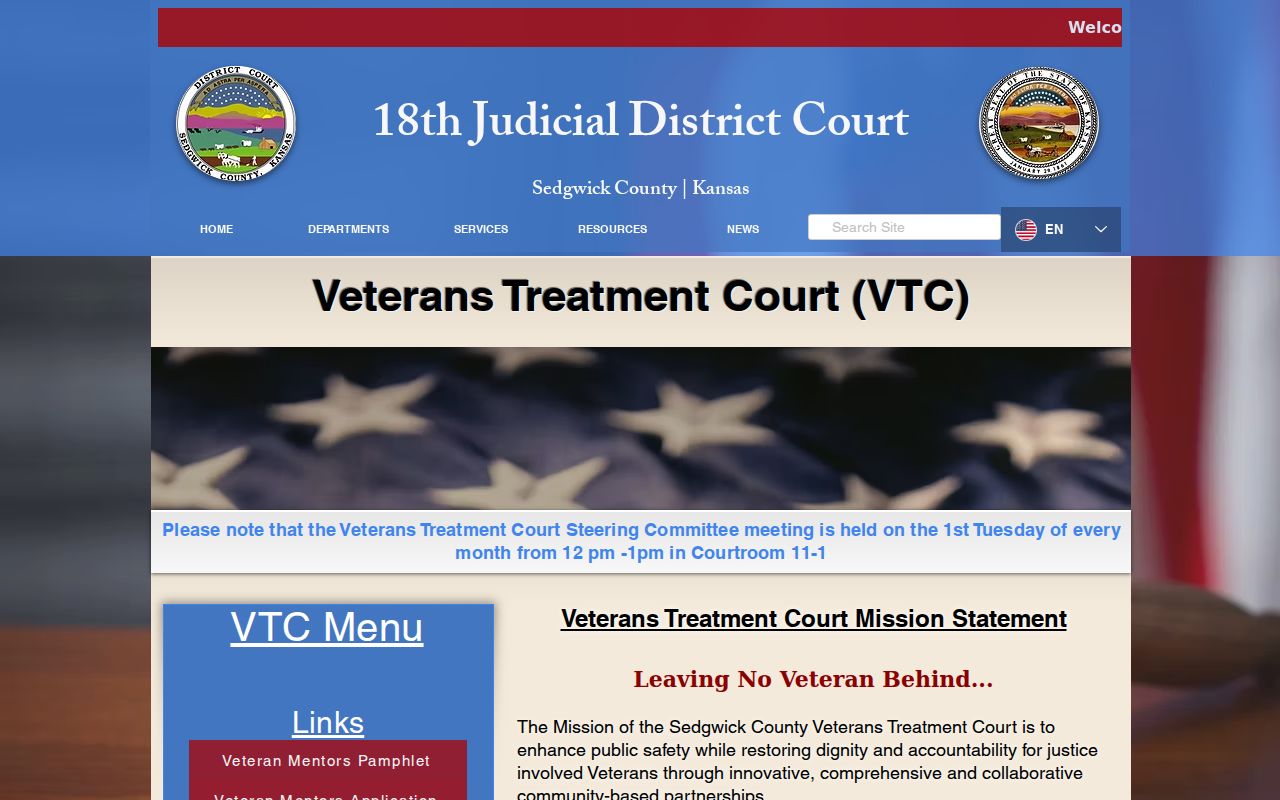
The program image helps identify the official specialty-court route. Eligibility and program status should be confirmed with the court rather than inferred from a CR calendar row.
Authorized filers use the court's mandatory eFlex filing guidance for criminal and other major divisions.
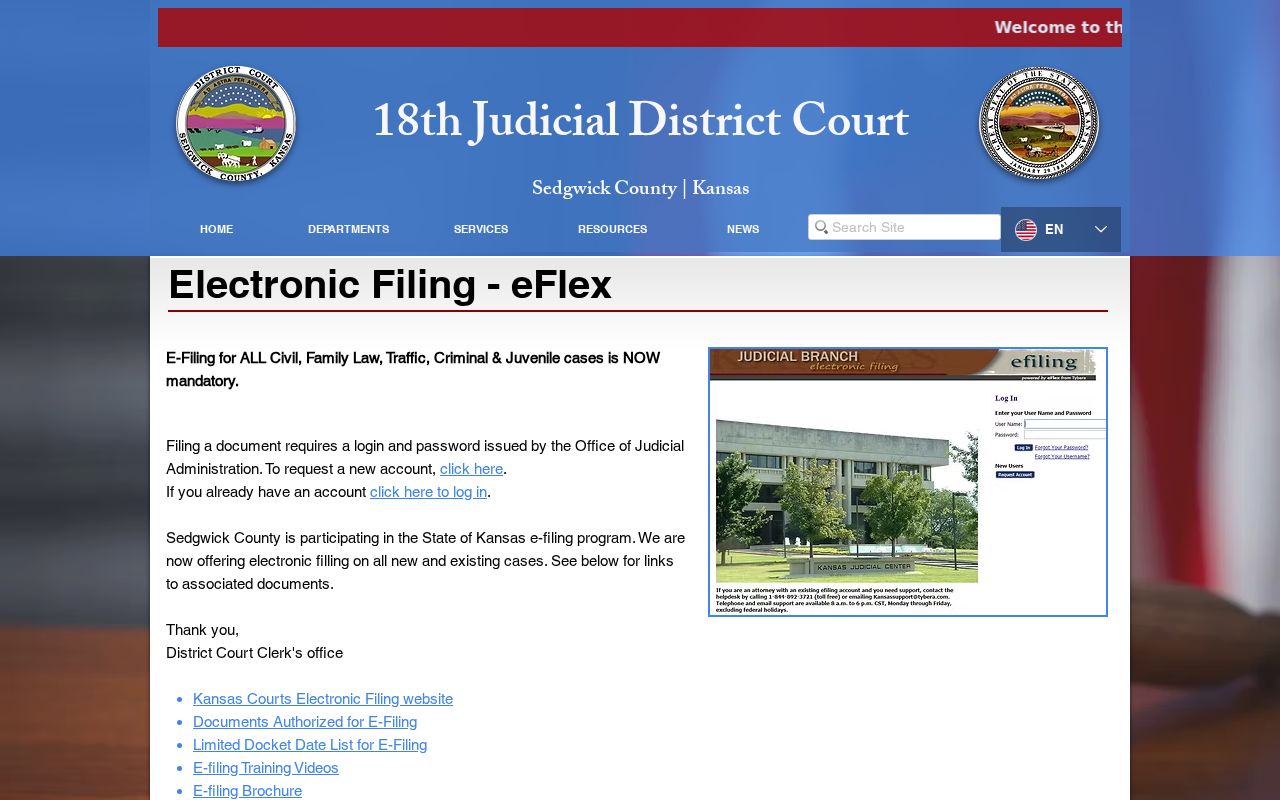
That separate filing layer explains why eFlex credentials do not provide a public criminal docket search.
Access Rules for Criminal Dockets
Kansas internet access is narrower than lawful courthouse access. DC18 excludes juvenile, CINC, expungement, grand-jury, inquisition, material-witness, sealed, and several other categories or images from the public portal. A blank web search therefore proves neither that a case never existed nor that a record is releasable.
Key rules: K.S.A. 45-218 requires action on an open-records request by the end of the third business day, though production may take longer. K.S.A. 22-2410 limits disclosure after an arrest-record expungement.
Sedgwick Criminal Records Fallbacks
When CaseSearch or the calendar does not answer the question, use the free public terminal in the sixth-floor Records Department. Call 316-660-5900 for routing, or submit a written request to sg.micro@kscourts.gov, by fax at 316-941-5358, by mail, or at 525 N Main, Wichita, KS 67203. Use one request per case number and name the exact complaint, journal entry, judgment, transcript, or docket sheet sought.
DC18 provides an estimate and requires prepayment. A plain print copy is listed at $0.25 per page, certification at $10 per document, and archived retrieval at $30 per case file. The Records desk, not the county Freedom of Information Officer or District Attorney, is the custodian for district-court copies. Sealed material remains unavailable without the required legal authority.
The request should separate the docket sheet from the paper behind a particular entry. Include the filing date or document title when known, say whether email or paper is wanted, and state whether certification is required. Broad requests can create research charges and delay. Small, non-archived requests made at the counter are generally filled when requested, while archived files may require retrieval. If the matter began as a city ordinance case, ask the municipal clerk first unless an appeal has reached District 18. If it is federal, use the Wichita federal clerk and PACER instead of the Sedgwick County criminal clerk.
Sedgwick Criminal Clerk Boundaries
The Criminal Department maintains the court case, but it is not the Sheriff incident-record office, the KBI criminal-history repository, the Department of Corrections supervision system, or the District Attorney's discovery file. Those records have separate custodians. A focused request for a complaint, journal entry, judgment, transcript, or docket sheet should go to the district-court Records Department with the exact case number and document date. This boundary matters when a CaseSearch result names a case but does not display the paper needed. It also prevents a calendar search from being treated as a general background inquiry. The approved use is locating and understanding a specific public court case, its setting, and its filed record.